Analysis model: gpt-5.5 xhigh
StarPort BBS by Future Crew - Technical Dissection
StarPort BBS, also catalogued as StarPort BBS (1), is a 13 September 1992
MS-DOS BBStro by Future Crew advertising the group's StarPort board. It is the
one distributed as STARPRT2.EXE, not the later 1993 StarPort BBS Intro II
source release.
Release year: 1992
The intro is visually stronger than its 6,400-byte size suggests: a sparse
starfield opens the run, a blue/gray space-station sprite slides into view, a
large cyan STARPORT outline crosses the screen, a Future Crew WHQ badge is
drawn below it, and a yellow bottom scroller advances over the composed scene.
The technical story is different from StarPort II. This one is a packed MZ
program with a paragraph-copy front wrapper and a 640x350 16-color display
path, not the later 2k-style source-available 320x200 dot scroller.

The runtime frames in this page are deliberately cropped to the upper display area. The full intro contains historical BBS contact lines in the lower block; those are not needed for the technical analysis and are not reproduced here.
Sources
- Pouet,
StarPort BBS (1): https://www.pouet.net/prod.php?which=5896 - Demozoo,
StarPort BBS (1): https://demozoo.org/productions/99553/ - Hornet 1992 demo index: https://ftp.scene.org/mirrors/hornet/demos/1992/00_index.txt
- Scene.org archive used for the local binary: https://files.scene.org/get/mirrors/hornet/demos/1992/spdemo3.zip
- Scene.org file page: https://files.scene.org/view/mirrors/hornet/demos/1992/spdemo3.zip
Archive
The examined copy of STARPRT2.EXE comes from spdemo3.zip on the Hornet
mirror. The archive bundles it beside SPDEMO3.EXE, but the StarPort program
is a separate executable and matches the production date/catalog metadata.
spdemo3.zip   151149 bytes
SHA-256       faa2b33d1125137c261a5de21c5eb9147436f4f0bd4a8a3b792dde7ac1d64f15
ZIP contents:
SPDEMO3.EXE   144529 bytes   1992-04-19 16:09
STARPRT2.EXE    6400 bytes   1992-09-13 20:37
STARPRT2.EXE hash:
07955e28e32375e96598e48cdc4c6767a6af95158e0ca3c8ec3d484b613564df STARPRT2.EXE
The same STARPRT2.EXE hash was already encountered as a side executable in
other 1992 archive work, which supports treating it as a widely copied BBS ad
rather than as a Space Pigs payload.
Runtime Capture
On 4 July 2026 I ran STARPRT2.EXE under DOSBox-X 2026.01.02, Linux SDL2
64-bit, with machine=svga_s3, normal CPU core, cycles=fixed 12000, dummy
SDL video/audio, and capture format=mpegts-h264. Timing zero is the start of
dx-capture /v STARPRT2.EXE.
The captured stream is MPEG-TS H.264/AAC, duration 24.669511 seconds. The
active graphics mode captured as 640x350. The stills below are top crops from
the stream; they retain the visual effect evidence and omit the lower contact
block.
| Timestamp | Frame | Notes |
|---|---|---|
00:00.500 |
 |
The intro begins in a sparse starfield. This is the cleanest frame for the background star layer before the station arrives. |
00:04.000 |
 |
The station sprite is entering from the right while the starfield remains active. |
00:07.000 |
 |
The station is now the main foreground object. The sprite uses a limited blue/gray/red palette and reads as a planar 16-color asset. |
00:09.000 |
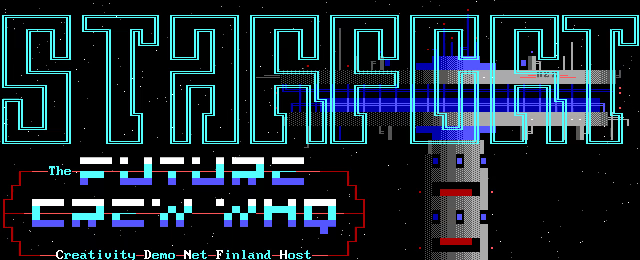 |
The large cyan STARPORT outline begins crossing in front of the station. |
00:12.000 |
 |
The Future Crew WHQ badge is visible below the wordmark, still above the cropped-out contact block. |
00:20.000 |
 |
The scene has settled into its main composition while the lower scroller continues outside this crop. |

The GIF covers the 00:03..00:10 window. This is the useful animated evidence:
the starfield is already running, the station glides into position, and the
large STARPORT logo sweeps over it. A still frame loses the timing relation
between those three layers.
Runtime-To-Code Concordance
The runtime media is cropped only to remove historical contact lines. The visible upper display area remains direct DOSBox-X evidence for the mode, layer timing, and animation order.
| Runtime evidence | Code path / data path | What it proves |
|---|---|---|
| Active 640x350 capture and crisp one-pixel strokes | EGA/VGA 16-color high-resolution display family, not mode 13h; the visual traits match the captured mode. |
The first StarPort intro is a high-resolution 16-color BBS composition, distinct from StarPort II's 320x200 dot-scroller style. |
00:00.500 sparse starfield |
Runtime layer model: background starfield over black before foreground assets arrive. | The opening is animated background work, not a static fully composed station/logo still. |
00:04.000 and 00:07.000 station entering/centered |
Blue/gray/red station sprite layer sliding over the active starfield. | The station is an independently timed foreground sprite layer. |
00:09.000 large STARPORT outline sweep |
Main cyan wordmark layer moving in front of the station. | The GIF is necessary evidence because the logo/station timing is lost in a single still. |
00:12.000 Future Crew WHQ badge |
Badge layer appears below the wordmark and above the cropped contact block. | The visible safe crop still includes the WHQ identity layer needed for analysis. |
00:20.000 stable station/logo composition |
Main layout has settled while the bottom scroller continues outside the crop. | The crop omits contact material but preserves the completed visual composition. |
| Bottom scroller omitted from screenshots | Raw text/data boundary around file offset 0x0B18 contains scroller phrase fragments mixed with control bytes. |
The scroller is text-driven, but the historical contact content is deliberately not reproduced. |
STARPRT2.EXE wrapper |
Tiny MZ header, CS:IP=0000:0003, eight-word paragraph copy loop, and jump to 05D3:04A8. |
The intro is behind a custom paragraph-copy wrapper, not a plain compiler-startup EXE. |
| Separate page from StarPort II | Different file, year, mode, and visual idiom. | The two StarPort analyses should stay separate despite the shared BBS purpose. |
The current code evidence is therefore strongest for the wrapper, display-mode choice, text/data boundary, and layer timing. It does not claim a fully recovered blitter listing for the hidden body.
MZ Wrapper
STARPRT2.EXE is a tiny MZ executable:
file size              6400 bytes
MZ reported size       6400 bytes
header size              32 bytes
relocations               1
min alloc              019Ah paragraphs
max alloc              FFFFh
SS:SP                  062D:0080
CS:IP                  0000:0003
entry file offset      0023h
relocation table       001Ch
The entry point is immediately after the 32-byte header:
0023  cld
0024  push es
0025  push ds
0026  push cs
0027  mov  ax,cs
0029  add  [0138],ax
002D  mov  dx,019Ah
0030  add  ax,dx
0032  mov  bx,ax
0034  add  ax,0493h
0037  mov  ds,bx
0039  mov  es,ax
003B  xor  si,si
003D  xor  di,di
003F  mov  cx,0008h
0042  rep  movsw
0044  dec  bx
0045  dec  ax
0046  dec  dx
0047  jns  0037h
0049  mov  es,bx
004B  mov  ds,ax
004D  mov  si,004Ah
0050  lodsw
0051  mov  bp,ax
0053  mov  dl,10h
0055  jmp  05D3:04A8
That is not a normal compiler startup. The loader copies eight words at a time
between moving source and destination segments, stepping both segment bases
downward for 019Ah iterations. This paragraph-level copy shape is a compact
relocation/unpacking wrapper: it rearranges a memory image before jumping into
the restored body at 05D3:04A8.
The file also contains an MZ byte pair near 0x1834, but parsing it as a
second executable header produces impossible values. In context it is better
treated as packed/data bytes that happen to contain the signature sequence, not
as a clean nested MZ payload.
Text And Data Boundary
The executable stores viewer-facing text with control bytes mixed into it. A
raw ASCII scan finds the main scroller phrase fragments around file offset
0x0B18, but disassembly there is intentionally nonsensical because the bytes
are data, not code.
Example of the boundary:
0x0B18  "The "
0x0B30  " Call St..."
0x0B43  "...ultimate..."
0x0B52  "...source..."
0x0B84  "... BBS..."
0x0BB3  "...music..."
This matches the runtime: the bottom scroller is text-driven, but the text is interleaved with timing/control or packed bytes. The analysis does not use the actual contact lines as evidence.
Display Mode
DOSBox-X captured the active graphics mode as 640x350. That points to the EGA/VGA 16-color high-resolution family rather than a 320x200 mode-13h path. The visual evidence agrees:
- The large
STARPORTletters use thin one-pixel cyan outlines. - The station is a limited 16-color sprite rather than a chunky 256-color mode-13h image.
- The lower badge and scroller use crisp high-resolution text/bitmap strokes.
- The capture aspect changes from the shell's 720x400 text mode to 640x350 once the intro enters graphics.
This makes the first StarPort intro closer to an EGA/VGA BBS-ad composition than to the later StarPort II point-cloud intro. It is still animated, but the animation is layer motion and scroller timing rather than 3D dot projection.
Visual Layers
The runtime sequence separates into a few simple but effective layers:
background      sparse starfield over black
foreground      blue/gray/red station sprite, sliding into place
main logo       large cyan STARPORT outline, horizontal sweep
badge           Future Crew WHQ title block under the wordmark
bottom text     yellow scroller, outside the cropped analysis frames
contact block   historical BBS details, intentionally cropped/omitted
The layers are not just static art. The station arrives before the full logo fills the screen, and the logo sweep runs over the station rather than being one fully composed still. The bottom scroller then keeps the scene alive after the main layout has stabilized.
Relationship To StarPort II
The 1992 and 1993 StarPort intros share the same purpose but not the same implementation style.
| Production | File | Year | Main visual idiom | Evidence |
|---|---|---|---|---|
StarPort BBS (1) |
STARPRT2.EXE |
1992 | 640x350 starfield, station sprite, large logo, bottom scroller | packed MZ sidecar and DOSBox-X runtime capture |
StarPort BBS Intro II |
SP2.COM |
1993 | 320x200 planar dot field and 3D dot-letter scroller | released source plus DOSBox-X runtime capture |
That difference is why the two pages should stay separate. The first intro is the circa-1992 BBS advertisement with the big logo and station composition. The second is the later compact source-release lesson in doing a 2k-style AdLib/VGA dot scroller.
Summary
StarPort BBS (1) is a small but polished 1992 Future Crew BBStro. Its
runtime strength is visual composition: starfield, station, logo, badge, and
scroller layered in a high-resolution 16-color mode. Its binary shape is also
interesting: a minimal MZ executable with a custom paragraph-copy wrapper, not
a plain compiler product. The safe cropped frames and GIF on this page are
therefore not decorative thumbnails; they document the actual layer timing and
mode choice that make the intro distinct from the later source-available
StarPort II.